 blog
Flowcode Alternative for Real Estate Agents: 2026 Guide
Table of Contents
- Why Real Estate Agents Need a Flowcode Alternative
- Real Estate QR Code Generator: What to Look For
- Dynamic QR Codes for Real Estate: Editable Destinations and Reusable Signs
- QR Code Lead Capture for Real Estate: Converting Open House Visitors
- Real Estate Open House QR Code: Workflow and Best Practices
- Pricing and Feature Comparison: Flowcode vs Alternatives
- Frequently Asked Questions
Last Updated: October 16, 2026
Why Real Estate Agents Need a Flowcode Alternative
Real estate agents juggle dozens of listings, each needing traffic, leads, and conversions. A flowcode alternative for real estate agents that offers flexibility, affordability, and control becomes essential when you're managing multiple open houses, brochures, and campaigns at once.
Locked-in solutions mean paying for unused features, no brand customization, and rebuilding codes whenever a destination URL changes. When a listing sells, static codes become dead weight. Dynamic alternatives solve this, but many charge premium prices or demand design expertise you don't have.
Scan Globe Now offers the world's first AI-powered QR code designer, enabling real estate professionals to achieve speed, flexibility, and professional results without hiring a designer. It provides branded dynamic codes in seconds, built-in lead capture, and engagement tracking.
Real Estate QR Code Generator: What to Look For
When evaluating a real estate QR code generator, focus on four core capabilities: dynamic destination editing, lead capture integration, scan analytics, and design quality without requiring design skills.
Dynamic QR codes let you update where a code points without reprinting signs. When a property sells, change the destination URL in your dashboard and the same code directs visitors to your next listing.
Lead capture is the second non-negotiable feature.
Scan analytics reveal which properties generate the most interest: how many people scanned each code, when, and from where. If one code gets 200 scans in a weekend, you know that open house was effective.
Finally, design quality matters. A generic black-and-white square looks cheap; a code with your logo, colors, and professional styling signals a detail-oriented, premium brand. The generator should make this possible without Photoshop skills.
Dynamic QR Codes for Real Estate: Editable Destinations and Reusable Signs
A dynamic QR code for real estate is only as valuable as its reliability over the life of the printed sign. The harder questions, what happens when the redirect breaks, the subscription lapses, or you migrate platforms, determine whether reusable signage actually saves you money.
How the redirect actually works
A dynamic QR code encodes a short redirect URL hosted by the QR platform, not your listing URL. When scanned, the platform's server responds with a 301 or 302 redirect to whatever destination you set in your dashboard. That's why you can change destinations without reprinting: the code points at the platform, and the platform points at your listing.
The practical implication: the platform is now a permanent dependency. If its servers go down, terms change, or you stop paying, your sign may stop working. Treat the redirect URL as infrastructure, not a marketing asset.
Print-life considerations agents routinely overlook
- Redirect type matters for SEO and caching. A 301 (permanent) redirect is cached aggressively and hard to change later; a 302 (temporary) is safer for frequently changing listings. Ask the platform which it uses.
- QR code error correction level affects scan reliability. Level H codes survive scratches, glare, and obstruction better than Level L, but are denser and need larger printing. For outdoor signs, insist on Level H and a minimum 2-3 inches square.
- Contrast and material matter more than design. A branded code on glossy laminate can fail in direct sunlight; matte finishes and high contrast scan more reliably outdoors.
- Physical durability is not digital durability. A metal sign may last five years; the redirect behind it may not. Match the sign's lifespan to the platform's contractual commitments.
What happens when a subscription ends
Behavior varies widely:
- Some keep the redirect live for a grace period, then deactivate it.
- Some redirect scans to a generic page or a "this code is no longer active" message.
- A few let you export the redirect mapping to re-host it yourself, but this is rare and usually enterprise-only.
Before printing on durable material, confirm the platform's policy in writing. If the answer is vague, assume the worst: your signs become dead weight the day you stop paying.
Data ownership and privacy
Scan analytics typically capture timestamp, approximate location (from IP), device type, and sometimes referrer; lead forms capture whatever fields you configure. Ask any vendor two questions:
- Can I export raw scan and lead data? If not, you're renting your pipeline, not owning it.
- Who is the data controller? Under GDPR and similar regimes, the agent or brokerage is usually the controller and the QR platform the processor. Confirm a data processing agreement if you operate in a regulated market.
A reusable-sign workflow that survives vendor changes
To get reusable signage savings without vendor lock-in, separate the two concerns:
- Use a durable, generic sign (metal or laminated plastic) with the QR code on a removable vinyl overlay, so you can swap codes without replacing the sign.
- Keep a spreadsheet of every printed code, its destination, and its host platform, so migration tells you exactly which signs need new overlays.
- Prefer platforms that let you export the redirect map, making migration a data operation, not a reprint operation.
This costs slightly more upfront than printing codes directly onto signs, but it caps your downside if a vendor changes pricing, shuts down, or degrades service, a scenario common enough that agents should plan for it.
QR code error correction levels explained
QR Code Lead Capture for Real Estate: Converting Open House Visitors
QR code lead capture for real estate turns an open house from a foot-traffic event into a qualified-lead machine. When visitors scan your code, they fill out a form collecting their contact information, interest level, and preferences before leaving.
The workflow is straightforward: a visitor sees a branded QR code at the entrance, scans it, and instead of a generic website gets a form asking for name, email, phone, and preferred features (bedrooms, price range, location).
This works because it removes friction: people are more likely to complete a digital form on their phone than write on a clipboard, so conversion rates typically beat traditional sign-in sheets.
Keep lead forms mobile-optimized and short: name, email, phone, and one or two qualifying questions. Every extra field reduces completion rates; the goal is capturing contact information quickly for personalized follow-up.
CRM integration is essential: leads should flow directly into your system so your team can begin outreach immediately. Manual data entry defeats the purpose.
Real Estate Open House QR Code: Workflow and Best Practices
A successful real estate open house QR code strategy requires planning before the event, clear signage during it, and systematic follow-up afterward.
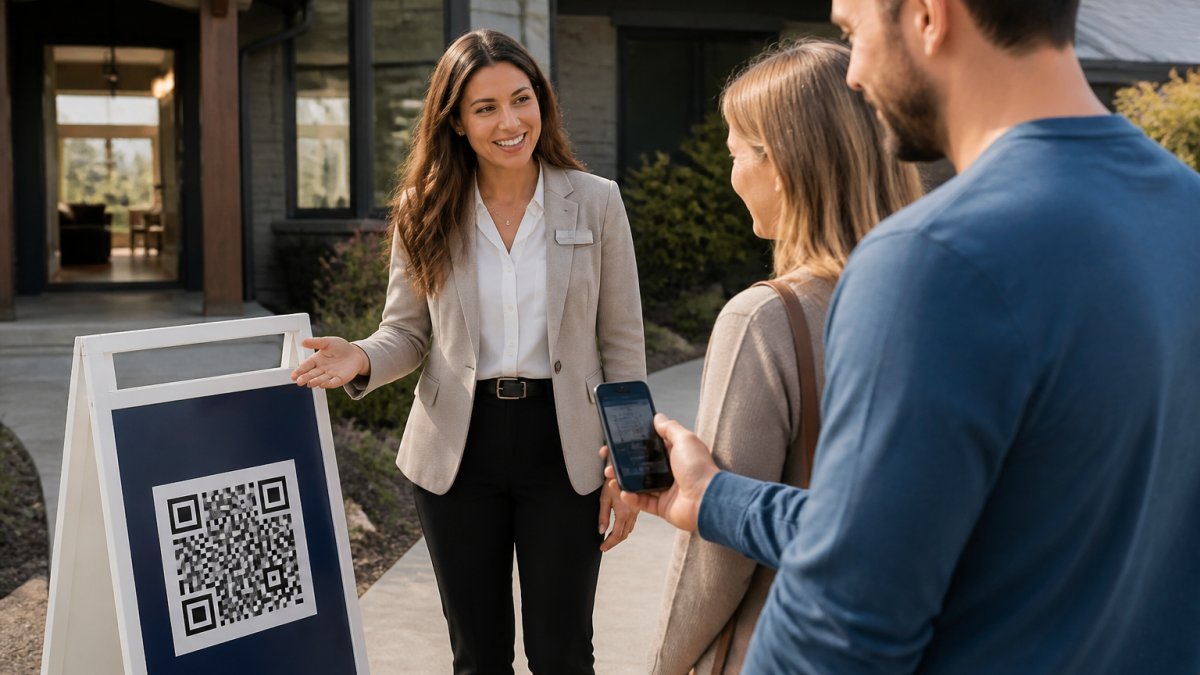
Before the open house, create your QR code and test it from multiple devices and locations to confirm fast loading and correct mobile display.
During the open house, position signage strategically: one at the entrance, another near listing information or property highlights, and optionally one in the yard visible from the street. Each placement should be clear and weatherproof.
After the event, follow up immediately: review captured leads within 24 hours, send personalized emails referencing the features each visitor indicated, and call qualified leads directly. Faster follow-up means higher conversion.
Track which properties generate the most scans. If one code gets 50 scans and another 10, you're learning which properties attract buyer interest; use that data to adjust marketing spend and open house frequency.
Pricing and Feature Comparison: Flowcode vs Alternatives
Most QR platform roundups stop at a feature checklist. For real estate agents, the decision comes down to four criteria that affect your workflow and wallet:
- Dynamic vs. static codes, Can you edit the destination after printing, or do you reprint every time a listing changes?
- Scan limits and overage behavior, What happens when a popular open house blows past your monthly scan cap?
- Lead data ownership, Can you export scan and form data, or is it locked inside the platform?
- Print-life risk, If you cancel, downgrade, or the vendor changes terms, do your printed signs keep working?
Use those four criteria to evaluate any Flowcode alternative. The shortlist below reflects the categories agents most commonly land in.
Category 1: Real-estate-focused QR platforms
These platforms are built around listing signs, open houses, and lead capture rather than general marketing. Scan Globe Now offers dynamic destination editing, built-in lead forms, scan analytics, and an AI-assisted design tool for branded codes without a designer.
Category 2: General-purpose dynamic QR platforms
Flowcode itself sits here, alongside other well-known dynamic QR services. These platforms are strong on brand recognition, enterprise features, and integrations, but pricing scales with scans and seats, and design tools are template-based rather than AI-assisted. For a solo agent running 10-20 listings a year, per-scan economics are hard to justify; for a brokerage with a marketing team, enterprise controls may be worth the premium.
Category 3: Free or freemium QR generators
Free generators are fine for a one-off flyer but a poor fit for real estate: most free tiers lock you into static codes or cap dynamic scans so low that one busy open house exhausts the quota. If you go this route, treat the code as disposable and never print it on a durable sign.
Category 4: CRM-native QR features
Several real estate CRMs now include a built-in QR generator. The upside: leads flow directly into your pipeline with no integration work. The downside: minimal design customization and lock-in to that CRM for the life of the printed materials.
How to decide
- Solo agents with a handful of listings: prioritize low monthly cost, unlimited or generous dynamic scans, and simple lead export. A real-estate-focused platform usually wins here.
- Small teams sharing signage: prioritize multi-user seats, shared code libraries, and per-agent analytics so you can see who is generating scans.
- Brokerages and property managers with hundreds of listings: prioritize bulk code creation, role-based permissions, CRM integration, and a contractual guarantee that printed codes keep resolving if you pause or downgrade.
Flowcode official pricing page National Association of Realtors technology resources
Frequently Asked Questions
Can real estate agents use QR codes to capture leads at open houses?
Yes. A real estate QR code generator with lead capture functionality allows agents to collect visitor information directly through a QR code scan at open houses. When visitors scan the code, they can submit their contact details, property interests, and follow-up preferences without filling out paper forms. This streamlines lead capture and enables agents to follow up immediately with qualified prospects who showed genuine interest in the property.
What should real estate agents look for in a QR code generator?
Look for dynamic QR codes that allow you to update the destination URL without reprinting signage, integrated lead forms to capture visitor information directly, scan analytics to track how many people engaged with your listings, and the ability to customize the QR code design to match your branding. For real estate workflows, the platform should support reusable codes for multiple properties and enable quick updates when listings change or properties sell.
Can a QR code on a property sign link to an updated listing?
Yes, if you use dynamic QR codes instead of static ones. Dynamic QR codes let you change the destination URL after printing, so your property sign can stay in place while the linked listing updates automatically. This is essential for real estate because property details, pricing, and availability change frequently. Without dynamic functionality, you'd need to reprint signs every time a listing updates, which is costly and inefficient.
How can real estate agents track QR code scans?
Most QR code platforms include built-in analytics that show scan count, timing, and sometimes device type. For real estate, this data helps you understand foot traffic at open houses, identify which marketing materials drive the most interest, and measure the effectiveness of your listing promotions. Scan analytics combined with lead capture forms give you a complete picture of visitor engagement and help you prioritize follow-up efforts.